
Find the best easy, nutritious, and flavorful baby led weaning foods to make starting solids easier. Plus: How to know when baby is ready for solids, the best ways to serve blw first foods, and how to ensure baby is getting ample nutrition.
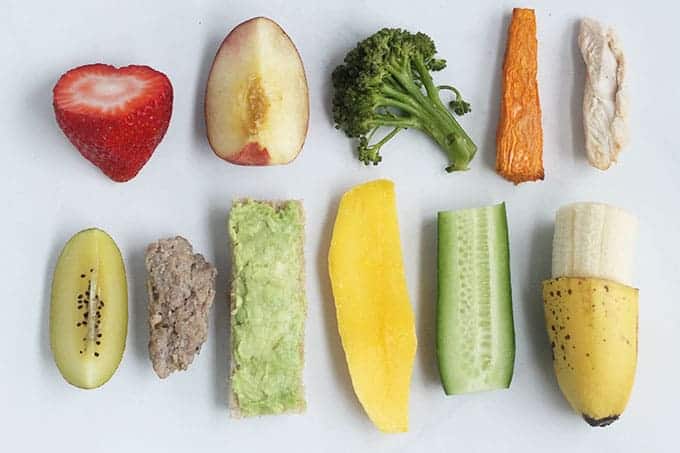
The feeding approach known as “baby led weaning” or BLW for short, is a style of feeding infants that allows them to feed themselves right from the start. There are so many nutritious blw first foods for baby (and full baby meals) to serve this way to offer a range of nutrients, flavors, and textures for a baby starting solids.
Quick Look: Baby Led Weaning Foods
- Prep Time: 5 minutes
- Cook Time: varies
- Total Time: varies (but is quick!)
- Serving: 1-4
- Flavor Profile: fresh homemade baby food flavors
- Difficulty: Easy, perfect for everyday baby meal ideas
- Why to Make: This is a quick and nutritious way to feed baby their first foods
SUMMARIZE & SAVE THIS CONTENT
Table of Contents
- Quick Look: Baby Led Weaning Foods
- Why this Method Works
- BLW 101
- How to Start Baby Led Weaning
- Best First Foods for Baby Led Weaning
- How to Cut Foods for BLW
- Baby Led Weaning Foods to Avoid
- Baby Led Weaning and Choking
- Baby Led Weaning Foods FAQs
- When to Introduce Potentially Allergenic Foods
- BLW Meals for 7-8 Months
- Best Tips for Baby Led Weaning Foods
- Ultimate Guide to Baby Led Weaning (and Best First Foods) Recipe
It can be hard to start BLW for parents since it may be a new technique to some of us, but once you get the basics down, it’s so easy. (And often, you can feed baby the nutritious foods you already have on hand!)
Why this Method Works
Baby led weaning foods are offered in thick finger-size pieces and is soft and easily squishable between your fingers. This way, the food is both easy to hold but has a low risk of choking. This post includes the best ones to start with.
Below I’ll cover everything you need to know to do BLW first foods with ease and make homemade baby food with confidence and with less mess!
BLW 101
This method became popular after the 2008 publication of Baby Led Weaning: The Essential Guide, by UK author Gill Rapley.
One of the many reasons that people are starting to opt for this style of feeding more and more is simply that it’s easy. In many cases, you can modify foods you’re already making to share with your baby and there’s not always a lot of separate cooking involved.
It also allows a baby to have control over what goes into their mouths, which sets a good precedent for letting them eat intuitively from the start.
TIP: Learn more on starting solids for all the info.
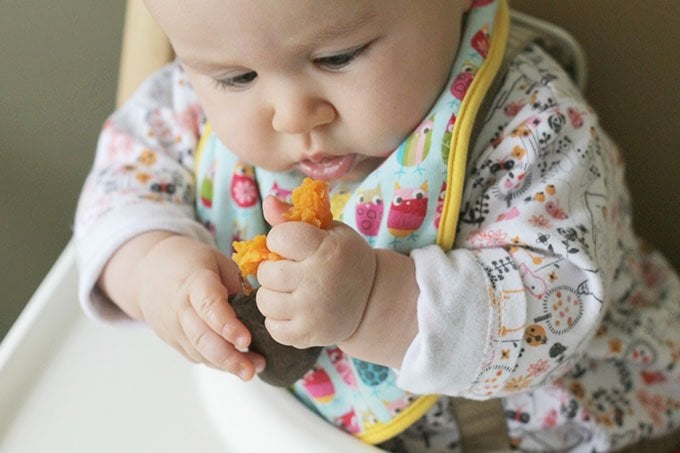
How to Start Baby Led Weaning
- Make sure baby has hit the milestones that indicate they are ready to start solids.
- Get the highchair ready and adjust the straps and foot rest as needed.
- Plan to introduce water when you start solids. I recommend one of the cups in my sippy cups for toddlers list.
- Choose 1 food to start with and plan to offer only 1 food at a time.
- Stop when baby starts to fuss, turns their head away, or shows any other signs of not wanting to continue. It’s usually fairly obvious when they are done!
TIP: Look for a baby highchair that allows a baby to sit up relatively straight so they can have good posture and better control over their arms and hands.
Best First Foods for Baby Led Weaning
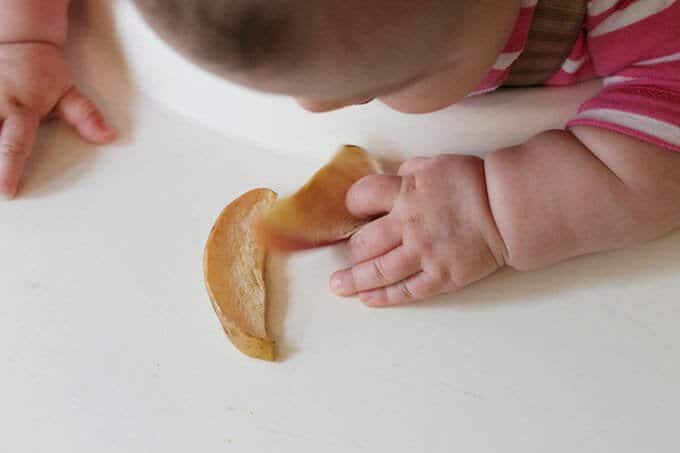
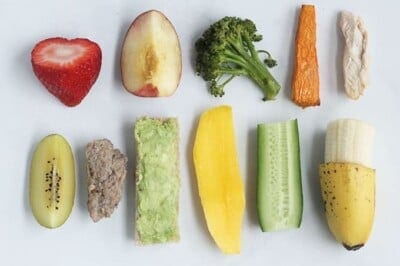
Here are some of our favorite first foods to offer baby led weaning style. You want foods to be finger sized so they are large enough that baby can’t force the whole piece into their mouth, and a shape that’s easy for a 6 month old to hold with their chubby little hands.
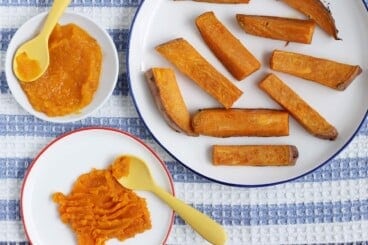
- Sweet Potato Baby Food, cut into wedges
- Sliced Baked Apples, skin on to help them hold together
- Broccoli for Baby (big enough for baby to hold)
- Melon slices
- Thick mango slice
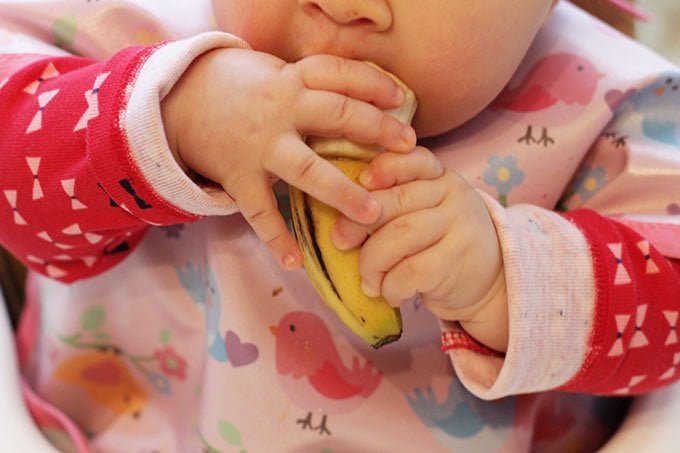
- BLW banana with some of the peel still on
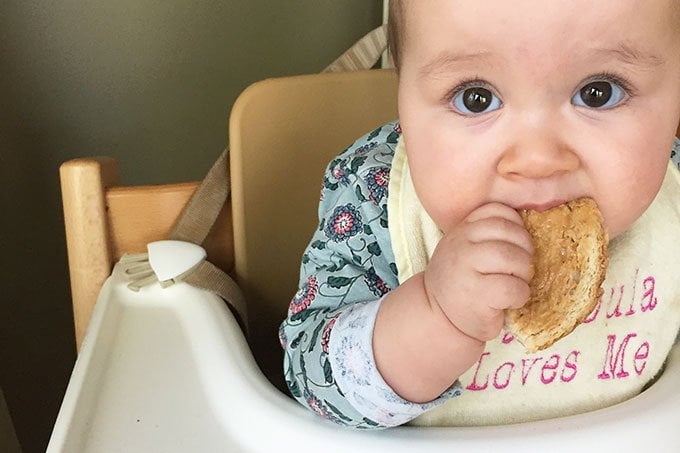
- Toast sticks with avocado puree
- BLW avocado spears (make sure the avocado is ripe and soft)
- Lamb or beef, on the bone or a large piece for baby to suck on
- Dark meat chicken, on the bone or a large piece for baby to suck on
TIP: The foods should generally be soft enough to squish between your fingers with the exception of the large pieces of meat. If baby gnaws a piece down into a smaller piece, replace it with a larger one to avoid them putting a too-small chunk of food into their mouth.
How to Cut Foods for BLW
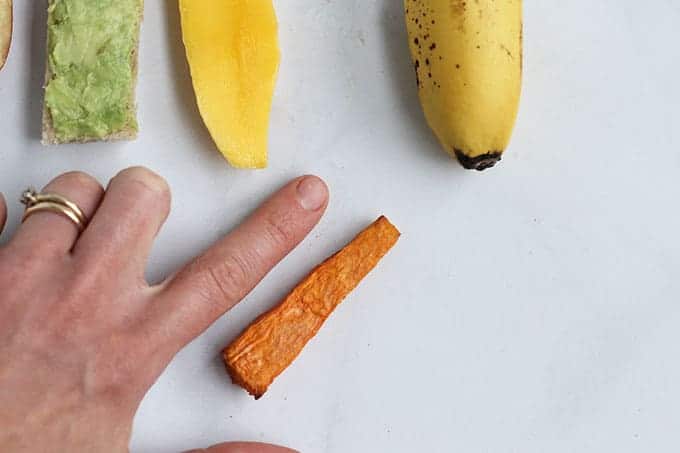
You generally want the food to be big enough that it would be difficult for baby to put the entire thing into their mouths. Here are some specifics:
- Foods that are roughly the size of a finger, so about a 4-inch stick.
- Foods that are easy for the baby to pick up—they can’t pick up small pieces until closer to 9 months when they develop the ability to use their fingers in what’s known as a “pincer grasp.”
- Foods that aren’t too slippery—so you can wash and leave some of the peel on fresh foods like bananas, avocado, kiwi, and mango.
TIP: You can also go even bigger if you’re worried about size. Think half of a slice of bread or a big chunk of watermelon.
Baby Led Weaning Foods to Avoid
You want any foods you offer to a baby while doing baby led weaning to be soft enough to squish between your fingers and safe for them to eat and digest. Plan to avoid:
- Anything hard, sticky, or crunchy (like raw apple or carrot, whole nuts, crackers, or a big spoonful or nut butter)
- Added salt
- Cow’s milk (which is difficult for kids under 1 to digest; plain yogurt is fine though)
- Added sugar (they simply don’t need it)
- Honey (to avoid a risk of botulism)
- Super slippery foods that would be hard for baby to hold (which can be frustrating)
TIP: Always sit with your baby and watch them try to eat. They are your best guide for making adjustments to the foods you serve.
Baby Led Weaning and Choking
There are many parents who dislike this method of feeding because it often sounds like a baby is choking. And while there are surely some incidences of choking, what’s more likely is that a baby will occasionally gag on a piece of food that gets into their mouth that they weren’t expecting.
But remember: Gagging is a sign that baby is doing what they need to in order to move the food around in their mouth as they learn to eat. It usually sounds more dangerous than it actually is.
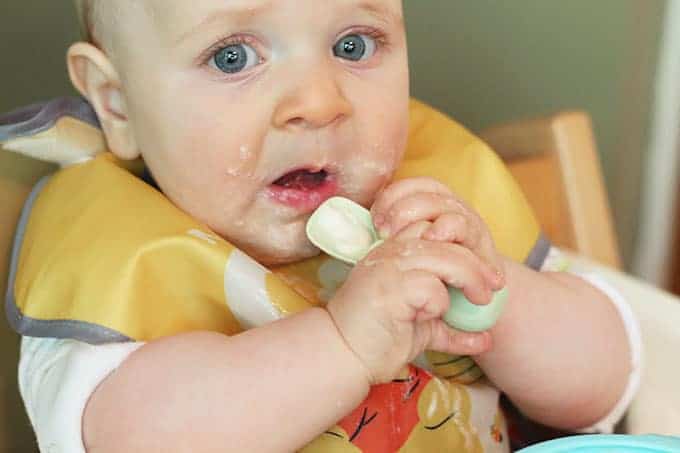
TIP: If the sound of gagging really freaks you out, you’re not alone. Consider offering more preloaded spoons with purees to start your journey more slowly.
Baby Led Weaning Foods FAQs
Probably not at first. There will likely be more tasting of the food than eating of it and that is totally fine. They will still rely on breast milk or formula at this age for their main nutrition, so don’t expect them to suddenly start eating full meals. (They’ll get there in a few months, but it takes time!) It is a good plan to include iron-rich foods for kids.
No! Gums are super strong and front teeth aren’t used for chewing—that happens when the back molars come in. Teeth really have nothing to do with whether or not a baby can eat solids.
If your baby is eating and then starts to turn her head away or just refuses to open her mouth, she’s done! Babies may also start to fuss if they’ve had enough. Learning this new skill takes time and babies can become tired fairly quickly into the process, so don’t expect them to always eat very much or to last very long at the table. This stage is about exploration!
I love offering purees on a preloaded baby spoon. To do this, the parent, puts some of the food on the spoon and hands it to baby. Then baby can bring the food to their mouth all by themselves. This can be a great way for anxious parents to let baby feed themselves, too.
When to Introduce Potentially Allergenic Foods
Research is showing that introducing these foods early can actually protect baby from developing an allergy. Talk to your pediatrician if you have concerns and if there is a food allergy in your family. (Find more in my BLW meaning post.)
TIP: My Peanut Butter Baby Food is a great way to offer peanut butter to babies.
BLW Meals for 7-8 Months
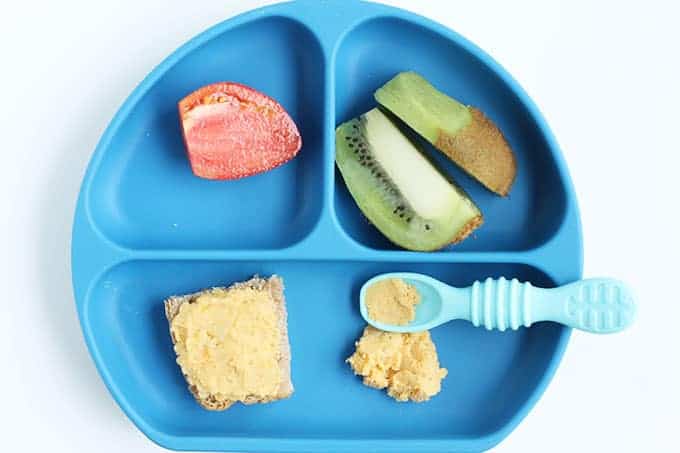
Until a baby is closer to 9 months and is able to pick up smaller pieces of foods, but after they have gotten the hang of one food at a time, I try to offer 1 or 2 foods they can feed themselves and 1 puree.
This offers them a chance to ingest more via the puree but still feed themselves a range of textures. You can do more or less food following the lead of the child.
TIP: My Baby Food Chart has loads of with ideas for BLW foods and purees by month. And find 9 month old food meals for older babies.
Best Tips for Baby Led Weaning Foods
Here are a few more tips to consider and review before you get started.
- Understand the gag reflex. Gagging is different than choking though and is most often a sign that baby is learning to move food around in their mouths—and to get it out of their mouths, which is a skill you want them to have!
- Set them up for success with a highchair that allows them to sit up straight and has foot support.
- Sit with them as you offer food. When they turn their head or start to fuss, embrace those signs that they are ready to end the meal.
- Vary the textures of foods you offer to start exposing baby to many right from the start. Try BLW pancakes, my full list of baby led weaning recipes, and baby led weaning breakfasts.
- Offer water in a sippy cup or small open cup.
- Remember that breastmilk and/or formula will continue to be the primary source of nutrition during this phase.
More Easy Baby Food

I’d love to hear any questions you have with BLW or if your baby had a first food that I didn’t list here. Please comment below to share your experience!
Ultimate Guide to Baby Led Weaning (and Best First Foods)
Ingredients
Banana
- 1 small ripe banana with peel on
Roasted Sweet Potato
- 1 small sweet potato + 1 teaspoon olive oil
Roasted Apple
- 1 small apple + 1 teaspoon butter or neutral oil
Roasted Broccoli
- 1 cup broccoli florets + 1 teaspoon olive oil
Sauteed Green Beans
- 4 green beans + 1 teaspoon olive oil
Melon
- 1 small piece watermelon or cantaloupe
Avocado Toast
- 1 slice whole grain bread
- 1 tbsp ripe avocado
Avocado Spear
- ⅛ ripe avocado
Lamb or Beef
- 1 lamb chop, roast, or steak
Pan-Seared Chicken Thighs
- 1 chicken thigh
- 1 tsp olive oil
- 1 garlic clove, optional
Instructions
Banana with some of the peel still on
- Cut a banana in half. Use a knife to gently cut around the peel about 2 inches down, leaving some of the peel on so that the banana is easy for baby to hold and less slippery.
Roasted Sweet Potato Wedges
- Preheat oven to 400 degrees and line a rimmed baking sheet with foil. Wash and dry the sweet potato. (You don't need to peel it.) Cut in half, then cut lengthwise into strips. Cut each strip in half again until each is about 1/2-inch thick. Slice in half horizontally if the sweet potato is very long. (Each strip should be about the size of your finger.) Place into a bowl and toss with the olive oil. Spread onto prepared baking sheet and roast for 22-25 minutes or until soft. Let cool slightly and serve.
Roasted Apple Wedges
- Preheat oven to 375 degrees F. Place the butter or oil into a pie plate or baking dish. Warm in the oven for a few minutes to melt. Remove from oven. Slice the apple into approximately 1/2-inch slices and discard the core. Place into the baking dish with the oil and toss to combine. Add cinnamon if desired. Bake for 28-34 minutes, or until tender when poked with a fork. Let cool slightly and serve.
Roasted Broccoli Florets
- Preheat the oven to 400 degrees F. Place the broccoli onto a rimmed baking sheet and toss with the olive oil, coating and mixing well until all of the florets are a little shiny and coated with oil. Roast for 15-18 minutes or until tender. Let cool slightly and serve.
Sauteed Green Beans
- Warm the oil in a large skillet over medium heat. Add the green beans and stir. Cover and cook for about 8 minutes. Remove cover and taste one to see if it’s soft enough. Cook for an additional minute or so as needed.
Melon
- Cut into a thick stick or a wedge and offer to baby.
Avocado Toast
- Mash the avocado very smooth with a fork. Spread a thin layer onto a toast stick and serve.
Avocado Spears
- Make sure the avocado is ripe and soft: Cut a thick strip of avocado and offer to baby. You can leave the peel on if that makes it easier for baby to hold (just wash it first).
Lamb or Beef
- Prepare a roast, steak, or chop without salt and with butter or olive oil until cooked medium well. Offer a thick slice at least the size of your finger or a drumstick.
Pan-Seared Chicken Thighs
- Warm 1 tablespoon olive oil or butter in a large skillet over medium heat. Add the chicken thigh and top with a few slices of fresh garlic, if desired. Cover and cook for 4-5 minutes. Remove cover. Flip over and cook for an additional 4-5 minutes uncovered or until a meat thermometer registers 165 degrees F.
Video
Notes
- Add spices like garlic powder, cinnamon, cumin, oregano, or any other nonspicy flavor you like to make these more interesting.
- Offer just one piece at a time when starting out.
- If baby gnaws a piece down into a smaller piece, replace it with a larger one to avoid them putting a too-small chunk of food into their mouth.
- Store any leftovers in an airtight container in the fridge for 3-5 days. Reheat briefly if needed.
- Remember that it’s normal for babies to take time to actually ingest the food. Part of the process is exploring all of the senses related to the experience of eating.
Nutrition
This post was first published October 2019.














Hi! My boy is exactly 6 months, but not sitting at all. Should i wait to start BLW? How long is acceptable? As some babies start sitting at the end of 7th month. Thanks!
The general advice is that sitting is a sign of readiness, but you are right that there is a range. If he can sit supported in a highchair and is sitting upright (not leaning back) and has good head control and is interested in food, then I would consider it okay to start. You can always ask your pediatrician too!
In your recipe for chicken thighs, what size of piece do give the babies? Mine is about 7 months old. Thanks
I would do a thick finger-size (or two fingers) size piece or you could do a whole smaller thigh (depending on how much you care about food waste). Once they get closer to 9 months and can pick up smaller pieces, you can shred it up very, very finely as long as it’s moist.
Thank you so much! Everything I needed to start my journey. I was really confused on how things should be prepared. So I’m so happy about this.
Thanks. so much for this informative article. Couple of questions: how often does the baby need to eat solids? Same like adults or 3 times a day is enough? What about portions? Do you start with smaller portions and go on bigger size? What is the optimal solution here?
Lastly, my baby has a very strong reflux (8 months old and still vomiting all the food out along with the milk) any tips on that?
Thanks a lot!
You can start with once a day and then gradually increase as it feels natural with the goal to be on three meals (and snacks if they seem hungry enough) by their first birthday. Start with a very, very small portion to avoid food waste (like one piece at a time) and offer more as baby gives you signals that they want more. For the reflux I would check in with your pediatrician. If they seem to be gagging on the food a lot, try seeing if you can slow it down a little by making things a little less slippery. So you could sprinkle avocado slices with breadcrumbs or offer toast strips to gnaw on, sprinkle some ground flaxseed on banana. If the food is too slippery and it’s moving really fast in their mouth, that could cause some challenges. But with actual vomiting after meals I would touch base with your dr. I hope that helps!
Thank you a lot for this article! Really helpful!!
Our baby has a gastro sensitivity and needs to start feeding solids earlier than 6 months. He’ll be just 5 months old. He already shows all the signs of readiness you mention. Do you think it will be ok to give him both purees and blw or is he too young for pieces? He can grab things, hold them, bring them to his mouth, sit, he looks at us eating, I’m asking just for the age part as I’m reading everywhere that they have to be 6 months old at least.
You can try the bigger blw style pieces. You may have to help him hold the food to his mouth a little. 6 months is the recommendation, but it’s often plus or minus a few weeks depending on the specific situation of the child. I hope it’s a fun experience for him to start eating!
Thank you so much for your reply! Looking forward to starting this new journey
This is what I was looking for thank you so many authors for sharing such a helpful guide with use. Such a sleek and responsive blog thanks a lot again keep sharing.
Should you start with food unseasoned then work your way up to the spices, or will it be too bland?
You can do it either way or both ways and see if baby has a preference! Some foods, like sweet potato, are likely fine as is. And others, even if they are plain, may be interesting enough from a texture perspective.
Thanks for the tips / super helpful – I was stressing out about what to feed my 8 month old baby as I introduce BLW method and this was just what I needed!
I’m so glad and enjoy the process!
First of all BLW says that your baby gets all the vitamins it needs at 6 months from milk. This is INCORRECT and bad scientific advice. Babies needs iron at around 6 months and the best source is meat/ pulses, you can’t get enough iron from BLW exclusively. A very young baby cannot eat a chunk of meat, a quick experiment with eating a chuck of meat without using your teeth is easily proven by an adult. So either the meat is a choking hazard for such a young baby with no real eating experience, or goes down to the digestive system unchewed, which the can cause indigestion plus iron/ minerals as can’t be fully absorbed.
Also the title of the approach (baby lead) is misleading. What difference does it make if I put the food in the blender, still the baby decides to eat the food or not! The only difference is that the risk of chocking is greatly reduced and the food can be better digested. Also we have all probably gone through the old traditional method, haven’t heard yet of any 30 year old who couldn’t eat their food by the time they were 2. What’s the advantage of this method, except for extra risks which I have seen with my own eyes?
Chocking is the 5th most common cause of death for children under the age of 5. What sensible parent would like to increase the chances of their baby having a choking incident? If you have any doubts, please try eating some food without chewing it. A young baby first doesn’t have molars to chew, second it doesn’t get the concept of chewing very well and also has a limited understanding of what can be eaten. Proof that the food is not chewed very well by the chunks of broccoli or whatever you may find during nappy change. Also for anyone who has tried BLW they will witness at least 1-2 coughing episodes during dinner if not something more sinister. No thank you.
This method is more dangerous and increases other health risks due to digestive issues.
Of course they might be some different types of food which the baby can practice their eating skills, like a long carrot which cannot be eaten but baby can put in their mouth. At least for the first few months when babies don’t have enough teeth BLW is not safe and of limited nutritional value for your babies. Any other advantage is superseded by baby safety
Thank you for sharing your opinion.
Gagging and choking are two different things. Everyone should absolutely learn how to deal with a choking baby, but they should be careful to be aware of the difference. Gagging is a healthy sign of your baby discovering how to eat WITHOUT choking. As you’ll note above, the author reminds you to STAY WITH YOUR BABY.
Babies get all of their nutrition from breast milk/formula before the age of 1. Iron stores get low, however, the baby does not get sick from this! It is recommended you start introducing iron-rich meats and pureed is great for this, but it is a cautionary thing. In baby-led weaning, perhaps making a pureed iron-rich mix and then dipping some of the BLW items in it, like a sauce? There are alternatives. It is not a dire “Your baby will die” situation. It is just best practice to introduce iron if you can.
BLW doesn’t use chewing, as obviously, they don’t have molars. Is this the first article you’ve come across about it? Note that the items need to be squishy, so that they can be bitten with gums and mashed with tongues. All of the foods listed here are great examples, and also, very traditional examples. How did people feed their babies 200, 500, 2000 years ago? They didn’t have blenders, and they didn’t spend hours of their days mashing food up. They chewed their food in their own mouths and gave it to baby, or they allowed baby to gum at things and eat them.
My first baby was fed entirely the traditional way. I’m on the third now, and we use a mix, because babies yearn to be involved! They do not wish to sit and be fed, they want to start themselves. A mix of styles is great. A big thank you to this author for the safety tips and the suggestions.
Thanks so much for sharing your perspective!
Your opinion and the way you wrote this came across extremely negative and shaming to those who clearly want to practice BLW (hello that’s what this article is about). This article clearly supports purées as well. Do you boo but allow others to do theirs as well.
This is a great read. Thank you . There is a lot of info out there and you covered most of what I was concerned about or unsure of. I’ve read lots of posts and articles and this has been the most useful
Why no milk? I just started my child on solids last week – he’s had occasional spoonfuls of plain, whole milk yogurt and also one of those squishy feeders with oatmeal made with whole milk. Should I stop for some reason?
Milk and cheese and cottage cheese are all fine—you just don’t want to do straight up cow’s milk on its own since it can be hard for babies to digest. You’re good!
at what age can I give Cutlery?
You can offer preloaded spoons soon after starting solids at 6 months
If you combine BLW and purées, do you still cut the food up the same?
Yes!
Hello! Thank you so much for the article. It was extremely helpful as my now 6 month old is starting on his solid food journey ? I just had a few questions. How often should i give baby the food in a day? Just once or 3 times. Also, when can i start introducing more than one choice a day and how to know when to include more and more? Thank you very much for the help?
You can start with once a day and gradually increase to three meals by 9 months as it’s easy for you with your schedule and in the mix with bottles or breastmilk. Usually, after the first few weeks of doing single foods, you can start offering those foods that baby has had (so if you know they do well with banana, you can offer it along with another or a new food). I was much less rigid about this than some since we had no family history of food allergies and baby had no ezcema, both of which would be higher risks factors for a food allergy. I would say by 7.5-8 months, if all is going well, you can be offering a mix of foods (or sooner if you aren’t particularly worried about reactions).
Hi! What are your sources, momma?
The American Academy of Pediatrics is linked throughout as a source.
I am so grateful I found your post, You’ve really covered up almost all the possible tips that a new mom should follow while preparing for first food for baby. I got a lot of information from your blog which can help me to prepare baby food easily. Thanks.
Wow!! First foods for baby is very essential tips for every parents. Thanks a lot Amy for sharing such an informative article. You are inspiring me for baby care. I’m sure most people can take notes from this article. One thing most people lack experience when feeding baby. I hope these tips will help me and I will apply for best first foods for purees.